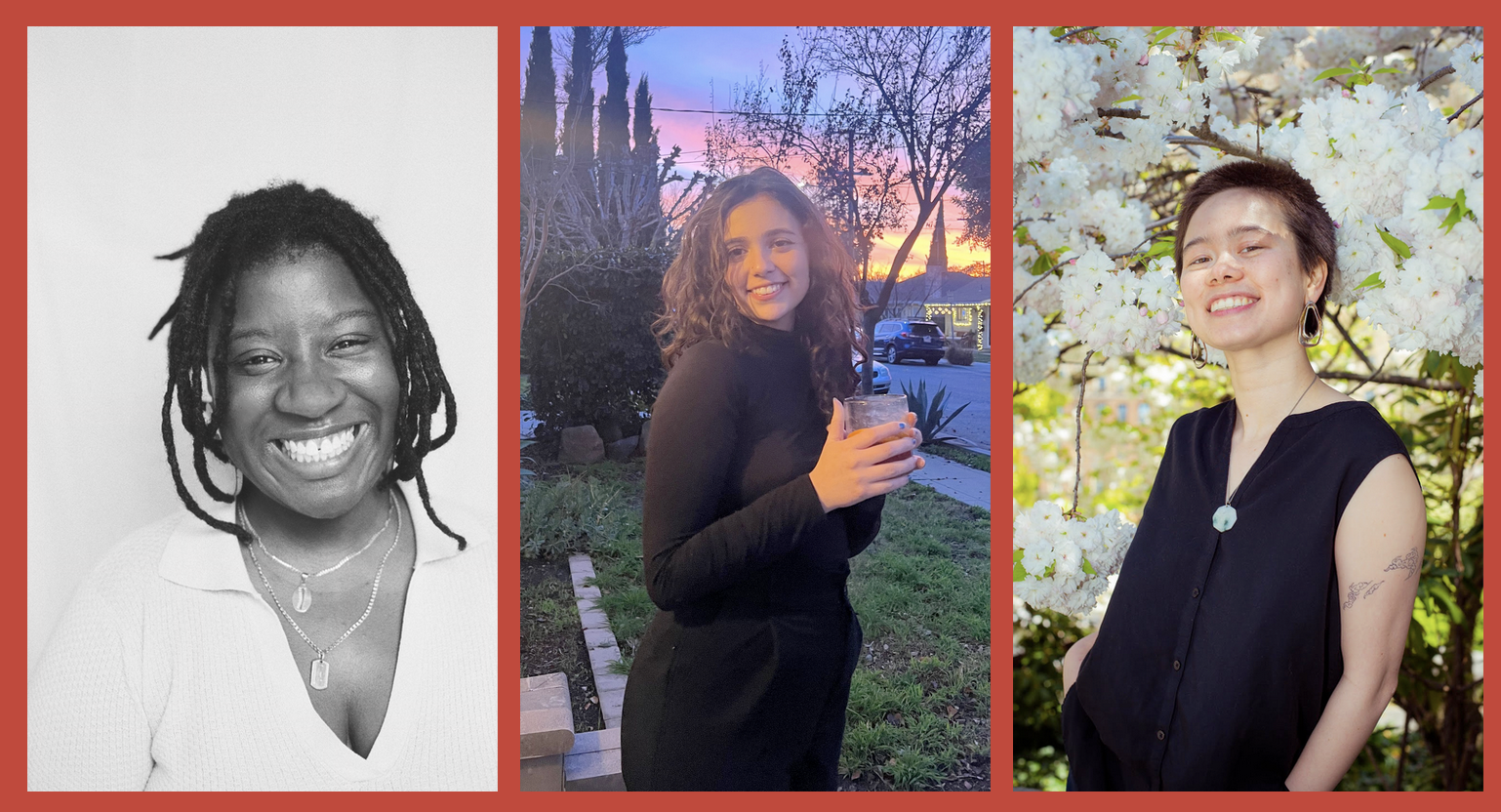


On a frigid Saturday in February, we three—Esmé, Ashley, and Citlali—gathered to see Gooey’s Toxic Aquatic Adventure at The Bushwick Starr, presented in partnership with ¡Oye! Group. After a two-hour-and-twenty-minute whirlwind of puppets, pizza boxes, and neon paint, we exited the theater dazed but refreshed—dizzy from both the cold and a wild and wondrous theatrical fever dream.
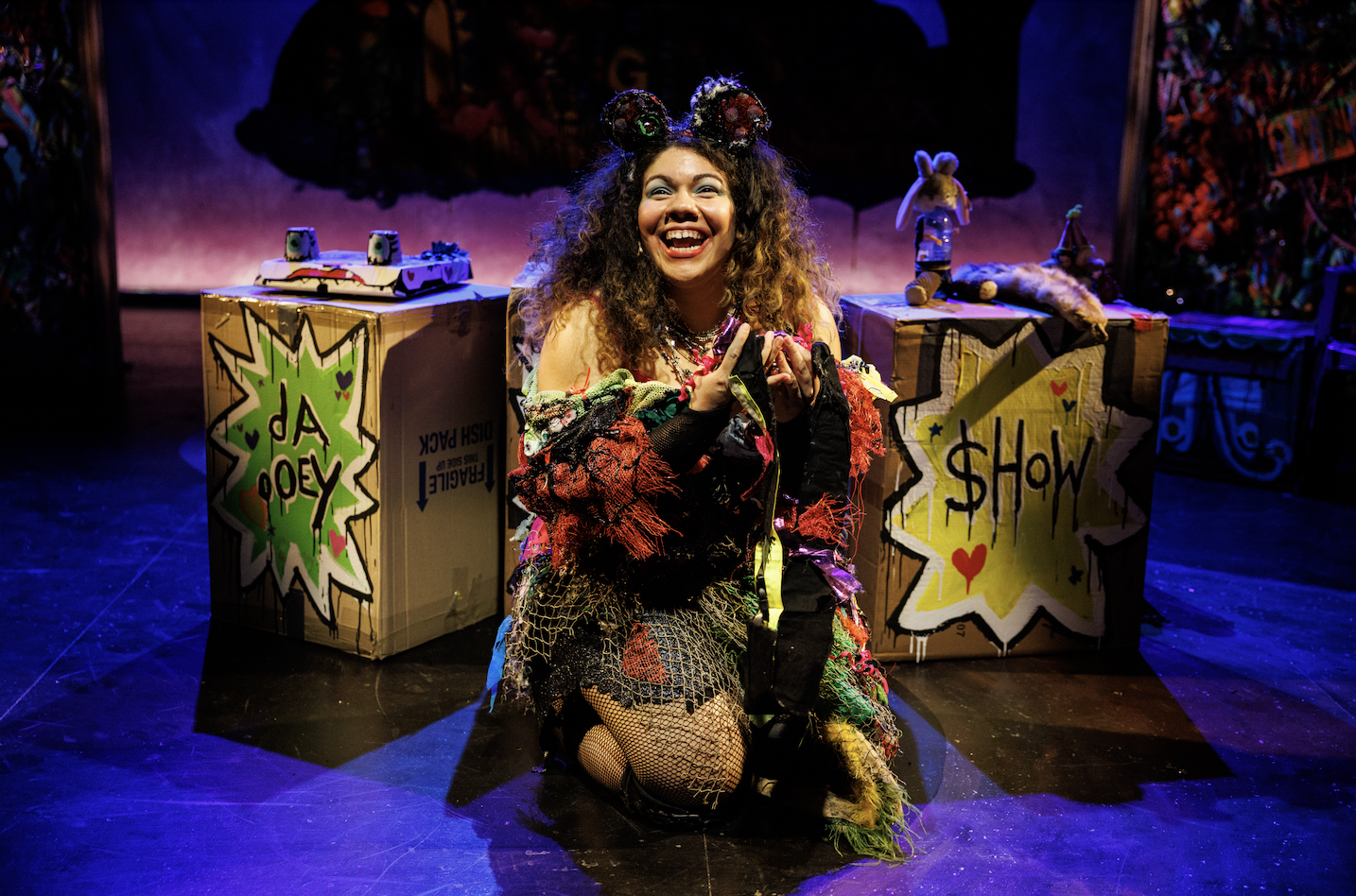
Gooey’s Toxic Aquatic Adventure was conceived and written by La Daniella, who also stars as Gooey, the show’s titular protagonist. Gooey is a “sorta mermaid” with a strong Brooklyn accent, who grew up amid the moldy pizza boxes and dead pigeons of Newtown Creek. Her only companions are the voices emitted from her glitchy, waterlogged radio—voices which sell her dreams of a theme park called G’Wond’rland.
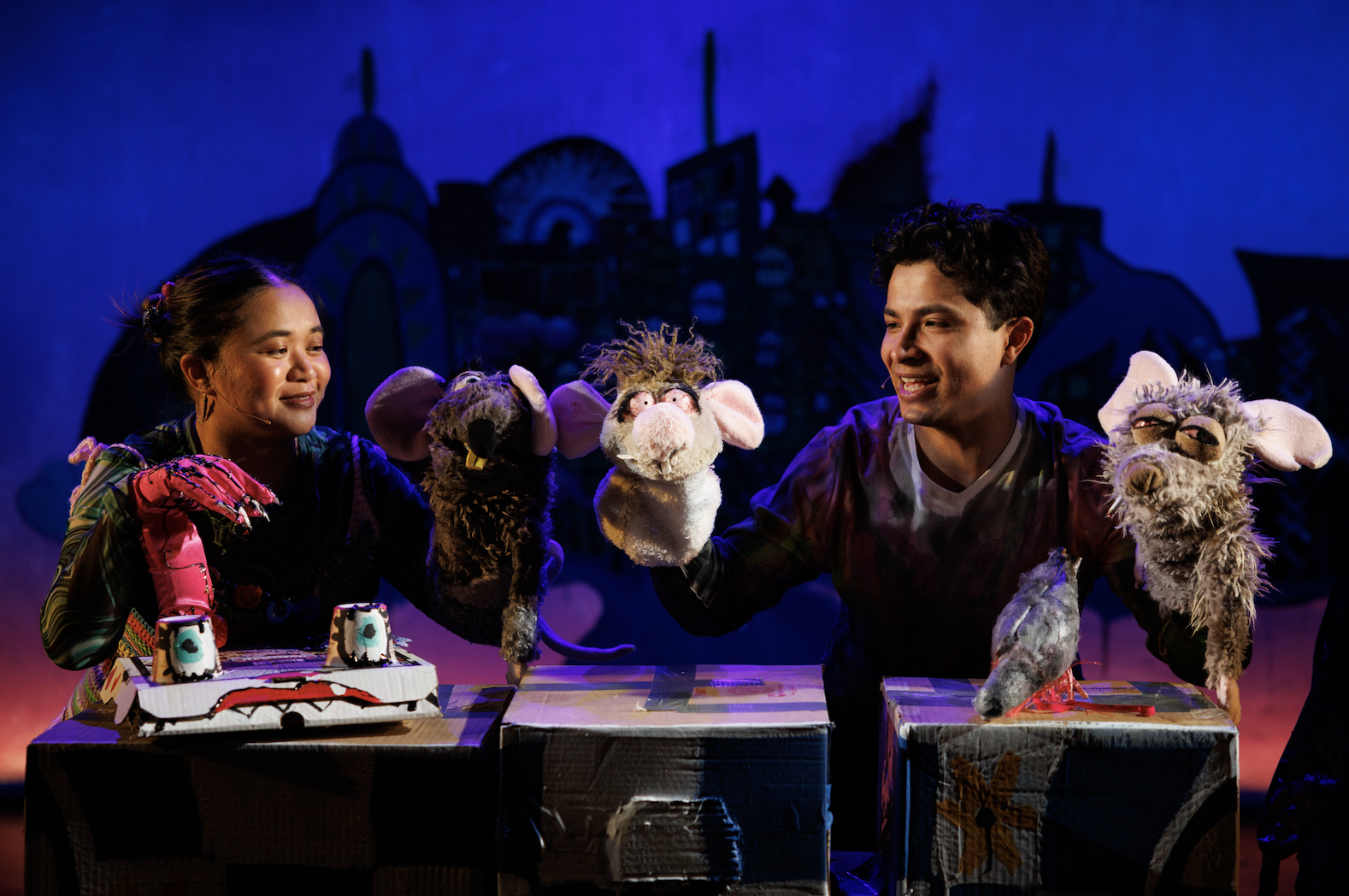
G’Wond’rland is an enterprise of power-hungry tycoon Fred Boss (León Ramos Tak) whose business empire threatens to take over Brooklyn. On her journey to find G’Wond’rland, Gooey finds friendship in Scabby the Rat and a glob of toxic waste (both of which manifest as puppets, skillfully manipulated by Amanda Centeno and Sushma Saha, respectively). These friends show her the dark side of G’Wond’rland, and together, they fight against its corporate power.
In the show’s afterglow, we remarked on what a relief it was to see “scrappy theater” onstage. We chatted about the ways in which the machines of theater and capitalism squeeze out imagination, withholding audiences from some truly good theater that’s out there. Below are our takes on Gooey’s Toxic Aquatic Adventure—a funny, anti-capitalist, hopecore, musical that we can all use during these times.

I DO NOT DREAM OF LABOR, BUT A PAYCHECK WOULD BE GREAT
By Esmé Maria Ng
In Gooey’s home of Newton Creek, she is alone, but seldom lonely. She surrounds herself with friends of her own creation including but not limited to a pizza box with googly eyes and a dead rat creatively repurposed into a puppet friend. Her imagination is her greatest strength, finding metaphorical roses to stop and smell despite the stench of corruption, environmental disaster, and capitalism that plague the world of Gooey’s Toxic Aquatic Adventure. It’s this imagination that lends itself to a desire to perform, and sparks her journey to G’Wond’rland so she can become the theme park’s newest cast addition– a mermaid princess.
In this delightful fever dream of a musical created by La Daniella with music by Ben Langhorst, both Gooey and the audience swim through a sea of absurdity at the center of which is a young woman who, really, wants to be an artist. She is obsessed with radio commercials, all of which promote the various companies under Boss Enterprises, and which also seem to be the main form of art that is available to her. She believes the narratives of these ads so genuinely that she chooses to travel a great distance so she can join the “family” of this entertainment conglomerate, as a means to both share her art and finally find some friends that don't require her puppeteering.
Many artists can relate to Gooey. We are living in a society consistently on the verge of political/environmental/economic collapse, and yet, it would be so great to get our work on the stage. So much so, maybe we’ll consider working for a corporate mouse that doesn’t always align with our values. With the increasing cost of living, many artists are unable to survive on their craft alone, so a consistent gig related to your artform that has health insurance is nothing to scoff at. There is a great fear surrounding the financial risk of the arts, causing a greater desire for theater that engages pre-existing IP, familiar storylines, and familiar faces. Gooey challenges this status quo with its daring sense of originality, reminding every artist in its audience that good art comes from human connection, not algorithmic dominance.
Of course, for Gooey, working for the mouse is not what she imagined at all and the musical satisfyingly rips out the puppet-guts of Boss Enterprise's CEO so Gooey can return to her (now non-toxic) home and make art with her true community. Gooey’s Toxic Aquatic Adventure leaves me with a hope for art and artists. The musical is a joyous love letter to whimsy and weirdness with a homemade aesthetic and tiny but mighty ensemble that are constantly stealing the scenes from one another. While the artists of real-life New York City are still figuring out how we’re going to balance the realities of art-making, capitalism, survival, and collapse, Gooey’s Toxic Aquatic Adventure gives us an example to hold on to.
MILLENNIAL CHILDHOOD DREAM COME TRUE
Ashley M. Thomas
What La Daniella is able to conceive in Gooey’s Toxic Aquatic Adventure is a successful feat for the inner child. The musical is an inventive gathering of cardboard boxes as props, stuffed rats as talking puppets, and a glittering severed hand as mother.
Orphaned as a baby mermaid, Gooey spends her time entertaining herself (and us) with her own “Gooey Ooey Talk Show,” alongside her makeshift puppet friends such as Flaps, a used pizza box, and Pidge, a pigeon carcass. On the radio, there’s a call for talent from Fred Boss, the business tycoon who owns & operates business in much of New York, and especially G’Wond’rLand. With this call, Gooey, (our Dorothy, the Black one!) sets out on her journey to the wonderful land of G’Wond’rLand. En route, she meets Scabby, a wise rat who knows that “nice gets ya nothing” smoothly puppeted by Amanda Centeno (who also puppets a few other friends).
Though suspicious of Gooey at first, Scabby eventually won over by her charm (and ability to sniff out food). However, that doesn’t stop him from warning her that G’Wond’rLand is nothing more than a capitalistic city of illusions. Gooey is hesitant to believe this at first, but after arriving in this supposed Oz, even she learns that it’s full of bad actors and smoke and mirrors.
This musical has all the makings of all our childhood joys—music and dress up and fighting the bad guys all seemed so simple back then. Today, we look at the world and things are a bit more complicated. We, as millennials, know that no one is coming to save us. It’s our inner child that will have to be the adult we never had; defeating forces set on undermining the future children behind us are to inherit.
But Gooey’s Toxic Aquatic Adventure is a reminder that justice doesn’t have to be sought alone. It can be done with color and imagination and play, and most of all, good collaborators. Cat Raynor builds a wonderful set that relives the best of my childhood days of watching The Wiz (1978) film on DVD. Then, between Kathy Ruvuna’s sound design, and Jon Schneidman’s musical direction, audiences are kept involved and on track all evening. Gaby Febland’s crafty puppet design is creative and reminds me that I’m not using the materials I have enough. Finally, with Sammy Zeisel’s consistent direction and La Daniella’s mastermind ideation, Gooey’s Toxic Aquatic Adventure is testimony that playmaking is the thing of the future.
DREAMS OF EMPIRES OVERTHROWN IN GOOEY’S TOXIC AQUATIC ADVENTURE
Citlali Pizarro
The revolution in Gooey’s Toxic Aquatic Adventure is executed by rats. Well, actually, it’s executed by tiny rat marionette puppets, manipulated by comedians of epic skill. The underestimated and cast aside, united, have power. History has seen musical after musical attempt such a sentiment, to varying degrees of success. In Gooey, though, the message feels utterly fresh, imaginative, and specific. A musical about stinky pests and radioactive waste is, to this disillusioned lover of political theater, a much-needed breath of fresh air.
Rather than frustrating, generic virtue signaling, Gooey’s story of unity is grounded in anti-capitalist politics that are consistent, coherent, and potent. In Gooey, the misfits aren’t just sympathetic characters who suffer from vague feelings of loneliness. They are a displaced and exploited underclass, united by their shared condition of oppression under Fred Boss’ rule. It is only when Gooey recognizes that shared condition, at the cost of the empty fantasies to which she clings so desperately, that she can build true community in rising up against it.
I’m not sure whether the story’s politics feel so coherent because the production does, or vice versa. Director Sammy Zeisel threads the text’s anti-capitalist spirit through every element of the production, from design to performances. The aesthetic of the production is fittingly scrappy and anti-commercial. The props, set, and costumes all look as though they genuinely could’ve been fished out from the bottom of the East River (positive connotation). The set (by Cat Raynor) is made up of painted cardboard boxes, and the hand puppets look well-loved. The “band” is one guy named Jon, who devotedly plays the keys, kazoo, and spoons. And, refreshingly, the performances—led by a lively La Daniella, and matched by the stellar ensemble of comedian-dancer-storyteller-puppeteers—are far from polished, prim, or, god forbid, sentimental. They’re appropriately loud, bold, and brash.
Expertly, Gooey makes light while taking the issues it tackles seriously. It’s hilarious, but it’s no joke. Capitalism—and gentrification, which maintains it—really displaces, isolates, and kills. The Fred Bosses of the world have blood on their hands. And no matter how many empty, liberal fantasies they try to sell us, they won’t save us from the destruction they cause. But the rats just might.
--
Gooey’s Toxic Aquatic Adventure is extended at the Bushwick Starr through February 28, 2026.