Oratorio? Maybe you’ve seen Handel’s Messiah, but it won’t really have prepared you for composer Heather Christian’s Oratorio for Living Things. It’s an onslaught. But it’s also a kind of camp oratorio, a wild contemporary reimagining of that cousin of the opera, a Baroque choral genre that tells a story in song.
One of the key elements of oratorios, and Oratorio, is the use of counterpoint. This show takes the ancient use of counterpoint and runs with it, reinvesting it, and in the process showing it to be an extremely modern form. Etymologically, “counterpoint” is paradoxical: it’s not really a thing, but a “counter” – it exists only in countering something else. It is a musical line which both accompanies and opposes another musical line. This is a state of being that’s also a mode of interrogation which ties the entire performance together. For example, the singer-actors often move in choreographed unison and yet they acknowledge and greet each other as others. In another moment, a solo is followed by one long full-company chord where the singers stagger their breathing, each individual voice blending into the whole, as the chorus sings the song in one long seamless breath.
But Oratorio for Living Things is more than an oratorio. It is a musical rampage through time, through genres, based on shifting harmonies that transition from Baroque to folk to musicals to gospel. The show itself is a counterpoint of genres and styles. And almost each song begins with a delicate melody, slowly building to an epic, energetic, drum-driven cacophony which can only be described as a form of profane worship. This pattern, building up to a stomping climax, is repeated throughout the performance – it becomes predictable, in fact, as a kind of repeated signature. This vivacious musical extravaganza leads the way for the wild range of lyrics – racing from indecipherable Latin phrases to fragmentary narratives about the history of violence of “my parents” (Hydrogen and Helium) to personal stories about being judged at your own bar mitzvah for not being a regular Synagogue-goer.
It is through this multi-media onslaught – and through running counterpoint – that Oratorio literally encompasses the history of the entire universe. Structured in three sections, three experiences of time – the cosmic, human, and quantum – counterpoint works to enact these experiences and their simultaneity. Counterpoint comes in the form of English interrupting Latin, in the form of elements iterating, being made, lines overlapping each other. “I complicate / I complicate / I bond and I complicate” is layered on top of, underneath, alongside, “coming from comets / it has no melting point.” Yes, sometimes the lyrics were reminiscent of Rent's cult song, ‘Seasons of Love.’ But the complexity of the various stories interrupting each other, weaving into and over each other until they eventually form a huge tapestry of sound, is profoundly stirring.
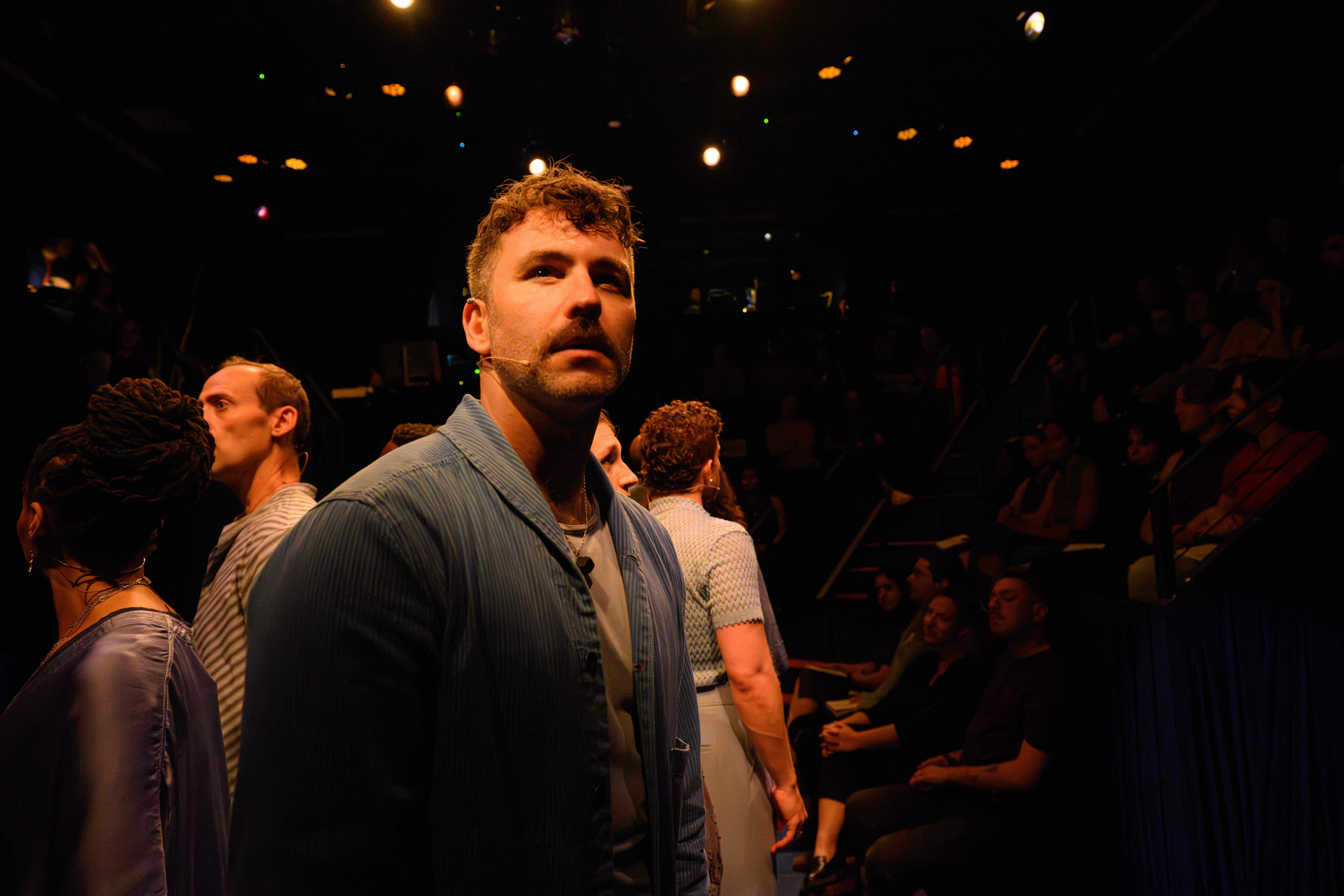
To enter the theatre, we have to pass behind the seating – a blue light haunts the underside of the tiered structure (scenic and environmental design is by Krit Robinson). We walk around and straight into the centre of the stage, on display. Blue light engulfs us. This is an in-the-round theatre, all the seats point to the centre, the stage. Except that the little patch of floor left in the centre is disappearingly small. Legs of audience members in the front row spill into the small space, and are illuminated by the stage lights. And while the stage becomes part of the audience, so the seating becomes the stage. Most of the performers spend most of their time standing on the stairs, close enough to make me uncomfortable. But they don’t stop there. The performers invade the boundary between us and them by making deep eye contact with each other and us. They hold out their gaze, offering it to us, asking if we want to take it. Intimidated at first, I soon learned to be unwavering in my gaze, performing looking-at in order to be looked at. And in the very last song, the entire audience was asked to rise. We did so, the lights were turned onto the audience, and suddenly we were all interacting, interrupting.
Oratorio enacts a temporal and spatial interrogation in our very bodies. Melisma confuses words and they become sounds. Then sounds morph into words. In one number, ‘In This Moment,’ “o i o i o i o / o iii i” becomes “know I know I know I know I know I know I know …” We are in a constant state of fleeting: fleeing one genre, one narrative, one melody, and one experience of time as we are immersed in an unimaginable experience of counterpoint where the times of personal memory, the quantum and the cosmic reflect on and ricochet off each other.
‘Oratorio for Living Things’ ran through November 23, 2025 at Signature Theatre Company. Production Photo by Ben Arons.