Writing your mother into your play can be an act of icy revenge or warm love. For Shayok Misha Chowdhury and Jared Mezzocchi, it’s definitively the latter — and the theatermakers love their moms so deeply they invited them onto their stages.
Well, essentially: in Rheology at Playwrights Horizons, Chowdhury’s mother Bulbul Chakraborty is the writer and director’s onstage co-star, and in 73 Seconds at The Lower Eastside Girls Club (produced by En Garde Arts), Mezzocchi’s mother Rosemary is present in voice and photographs. She is battling Alzheimer’s, away from New York City, but it is to Mezzocchi’s credit that his mom feels palpably present on stage.
So do Chowdhury and Mezzocchi, who both offer a platform for their mothers’ stories. Showcasing maternal love for these two hardly takes acting, even as each production takes its own shape. There is one more key similarity bridging these artists: both sons have mothers who worked in STEM fields long before more women did, and each writer honors his mother’s career while discovering the theatricality within it.
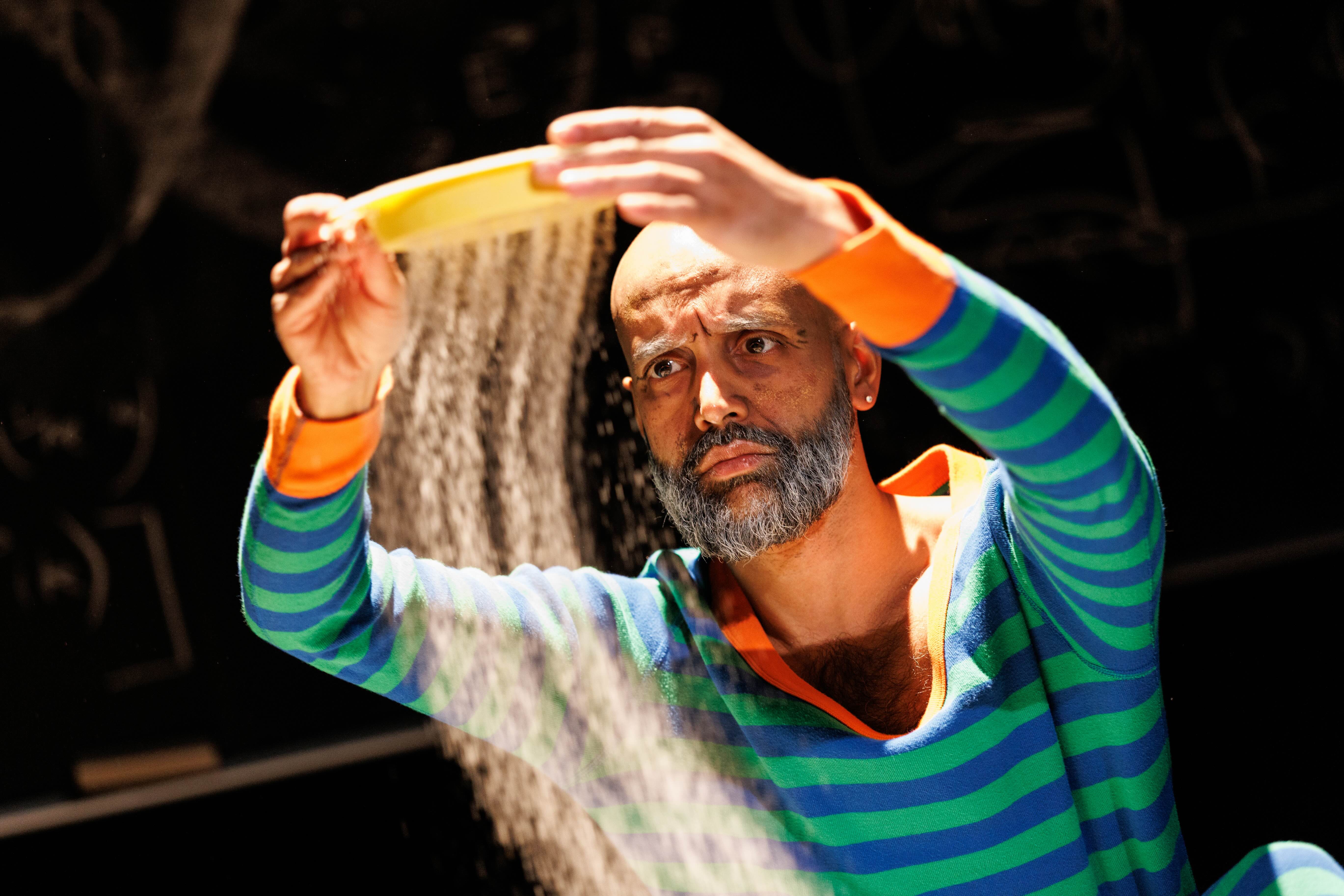
In Rheology, Chowdhury explains that he created his show out of fear of losing his septuagenarian mother; the play, then, is his funny way of (in his words) forcing her to spend time with him. He says he won’t survive her death, but she says that’s just a theory. Her background as a physicist taught her to play and ask questions, not unlike a playwright’s craft. Much of Rheology, then, is a breathing experiment: to prepare Chowdhury for the inevitable. He tries out various ways of embracing his mother’s death; some goodbyes are scored and melodramatic (like clutching his mother in bed as pounding rain plays on the sound system), and others are surreal and moving (like digging up bones after playing in a sandbox).
Chakraborty’s scientific work concerns sand’s rheology — how it operates in relation to the forces and containers that disturb and shape it. It is a heady but poetic topic that Chowdhury’s writing and Chakraborty’s performance make lucid: in an opening sequence, Chakraborty teaches the audience directly, working on a chalkboard with video projections of sand’s fluidity, and whatever bad memories you may have of high school physics Chakraborty quickly dispels with her quick wit and twinkling eyes.

What is moving here is Chowdhury’s desire to understand his mother’s career, and her ability and willingness to participate in his. Some mothers may find it a nightmare to step onto stage with their professional theatermaker son, but Chakraborty knows that understanding scientific theories is only half the battle: they must also be shared in a comprehensive, persuasive way that is not unlike performance. Because of this, it feels as if Chowdhury (who also directs the piece) didn’t have to do much crafting; all he had to do was pass his mother the spotlight and revel in her presence.
This is not a grace Mezzocchi is afforded given his mother’s disease. But as in Rheology, Mezzocchi tries to understand his mother’s work — specifically that, before she became an eighth-grade math teacher (and Math Counts club advisor), she worked for NASA. Rosemary can no longer recall that chapter from her life, but Mezzocchi knows why it ended. She got pregnant with him, barring her from possibly joining a space mission — on the Challenger.
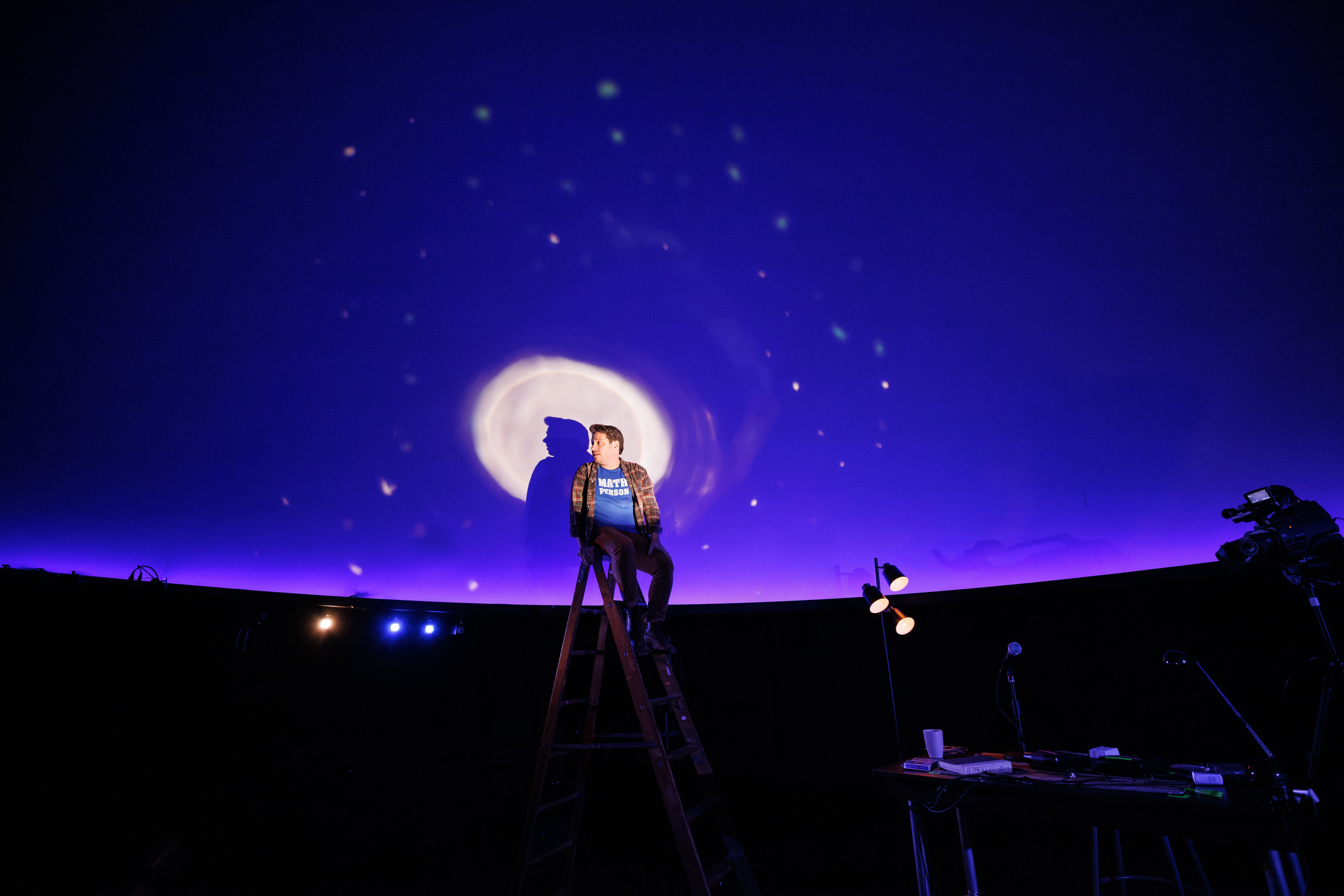
It’s a compelling premise that doesn’t always take off. 73 Seconds refers to how long the Challenger was in flight before it exploded, but Mezzocchi has spent a lifetime trying to piece together his mother’s varied career, which she only shyly discussed. But those humble roots are given grandiose life at The Lower Eastside Girls Club’s planetarium, where the reclined chairs rival the comfort of AMC’s. With the audience’s angled skyward, Mezzocchi must compete with the stars. It’s a tough task, partly because, in Jeanette Oi-Suk Yew’s video work, the overhead projections can dazzle. It is also partly because carrying a solo show is no small order, and Mezzocchi — often a brilliant director and thinker in digital designs — is less assured as a performer and writer.
Some lines, like “I thought life would get easier as I got older,” may feel true but ring hollow. And while director Aya Ogawa keeps the play’s pace brisk and the heart sincere, they struggle to find a clear visual vocabulary or props that telegraph the inner love of a son also battling his guilt for being away from her.
One final gesture, however, does launch the play into the stratosphere. Mezzocchi positions a small jar before a camera so that, on the video feed, it looks as if he is held within an astronaut’s helmet. It is simple, theatrical, and fulfilling. After impersonating his mother’s perky voice throughout the play, he truly transforms into her as she prepares for the lift-off that never was. On the planetarium’s arced ceiling, a video of a spaceship rises.
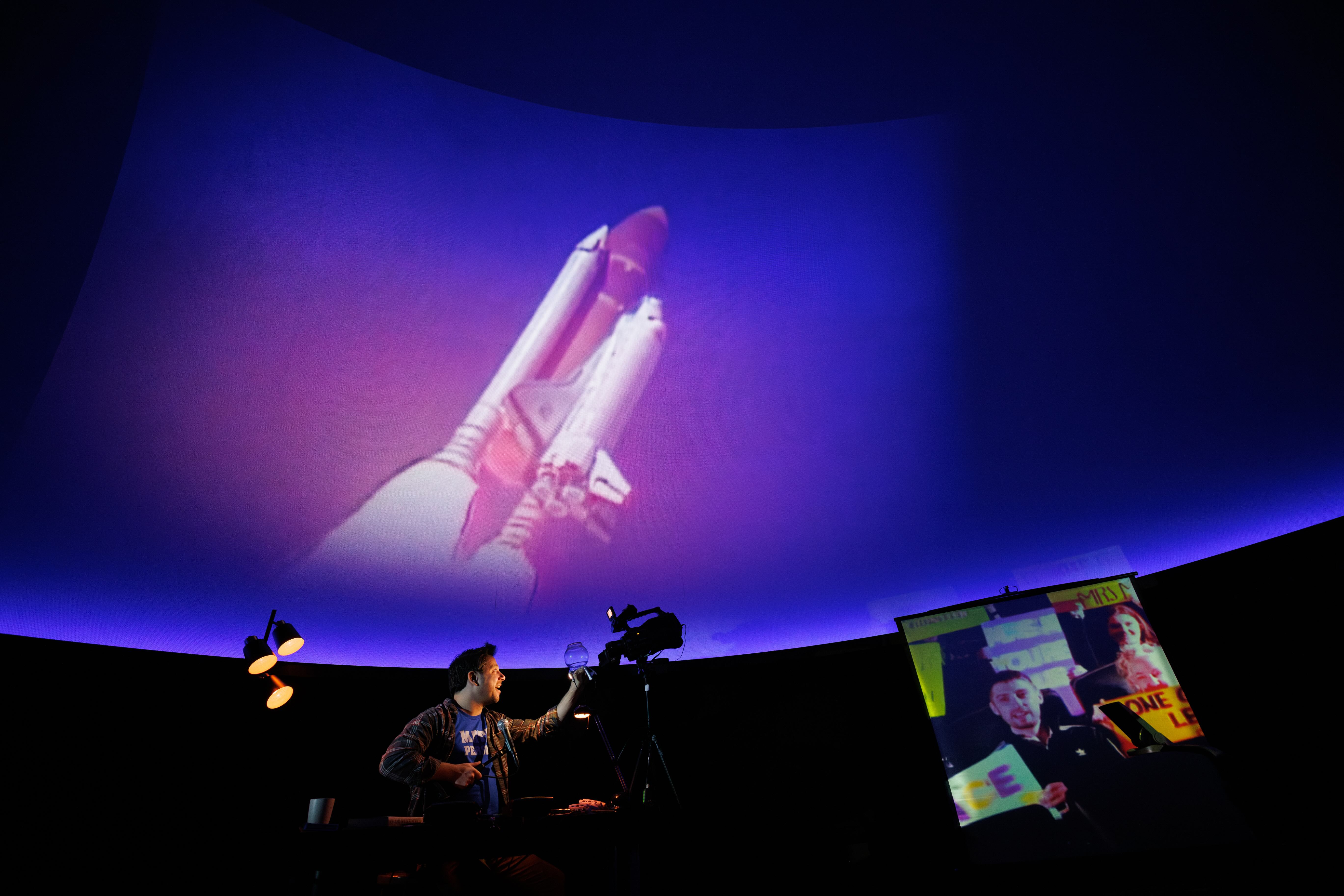
“I am a mother. I am a teacher. I am an astronaut,” Mezzocchi says, celebrating Rosemary’s multitudes.
In Rheology, Chowdhury is able to highlight his mother’s skills and life’s work before us, but in 73 Seconds, Mezzocchi theatricalizes the promise of what his mother’s could have been. She didn’t get to go to space, but there is no guilt here: Mezzocchi knows what his mother is capable of. And neither he nor Chowdhury are afraid to show it.
--
Rheology runs at Playwrights Horizons through May 29, 2026. 73 Seconds runs at the Lower East Side Girls Club through May 18.