Juliette Lewis launches The Rocky Horror Show on an appropriately off-key note. In a dapper usherette suit, the ’90s celebrity turned aughts punk colors just outside the borders of melody, crooning “Science Fiction/Double Feature,” that pastiche lullaby immortalized by disembodied lips in the 1975 film’s draggy Not I intro. Lewis’ Off-Off Broadway voice is a beguiling invitation into the grab-bag of Rocky Horror (which first premiered on the West End in 1973) with a matching grab-bag cast: From Broadway’s Persephone (Amber Gray) to Disney’s Gaston (Luke Evans) to A24’s Joy Wang/Jobu Tupaki (Stephanie Hsu) to SNL’s Debbie Downer (Rachel Dratch). If you look closely enough, you’ll see drag demon Christeene (Paul Soileau).
It’s exhilarating in theory to think of actors from so many corners of thespianism coming together to flout Broadway polish with this thrift store horror comedy: Rocky Horror’s hodgepodge homage to outsiders performed by a purely virtuosic cast would be a failure of vision. As director Sam Pinkleton told Broadway.com, “I want it to be a group of people you look at and think, ‘how did those people end up together?’ Because I think that’s what Rocky Horror is and Rocky Horror does.” But I’ve also always found Rocky Horror itself exhilarating in theory: a show/film whose anarchic energy spirals into inertia, a long comedown after the early explosive introduction of its intergalactic libertine antihero, Dr. Frank-N-Furter.
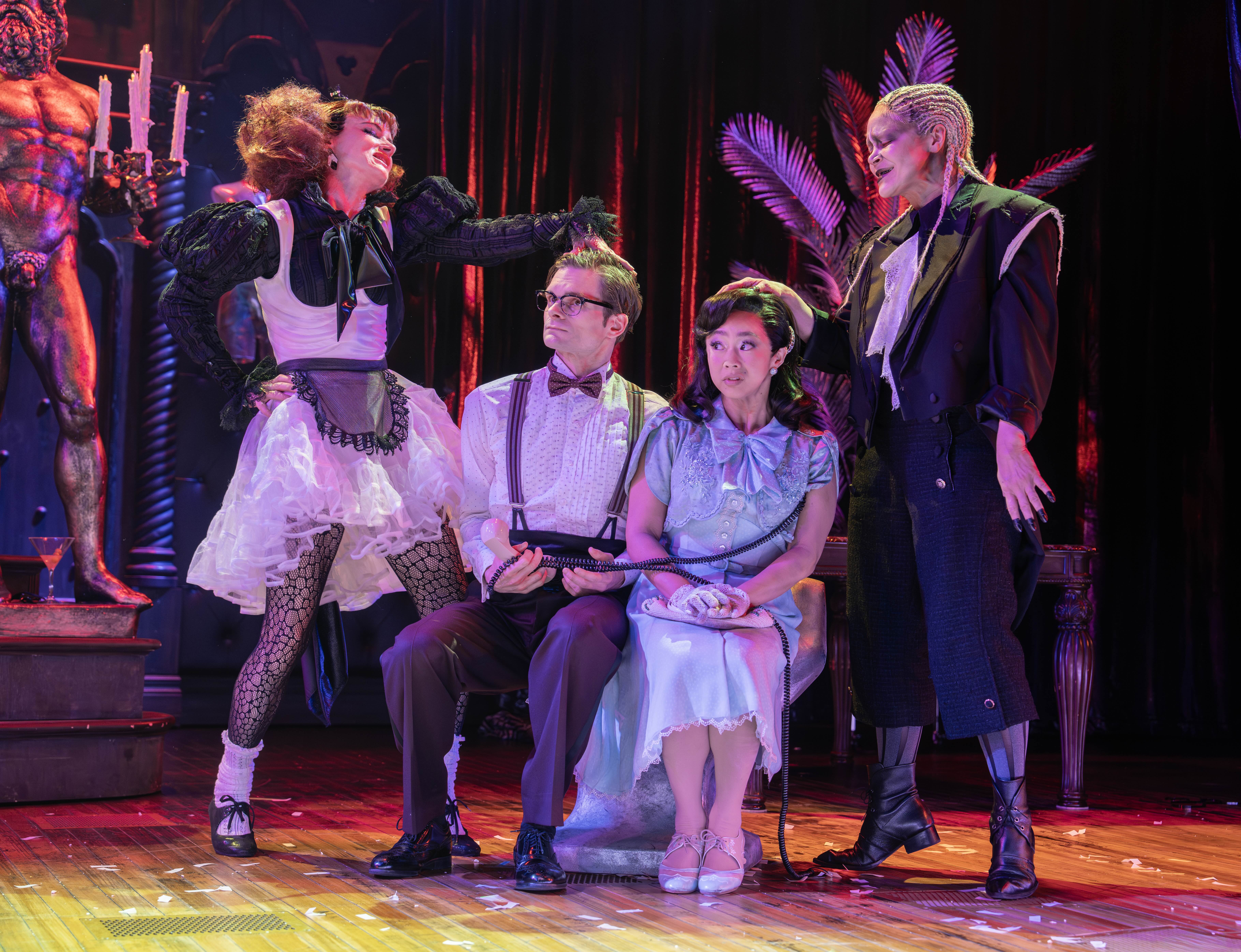
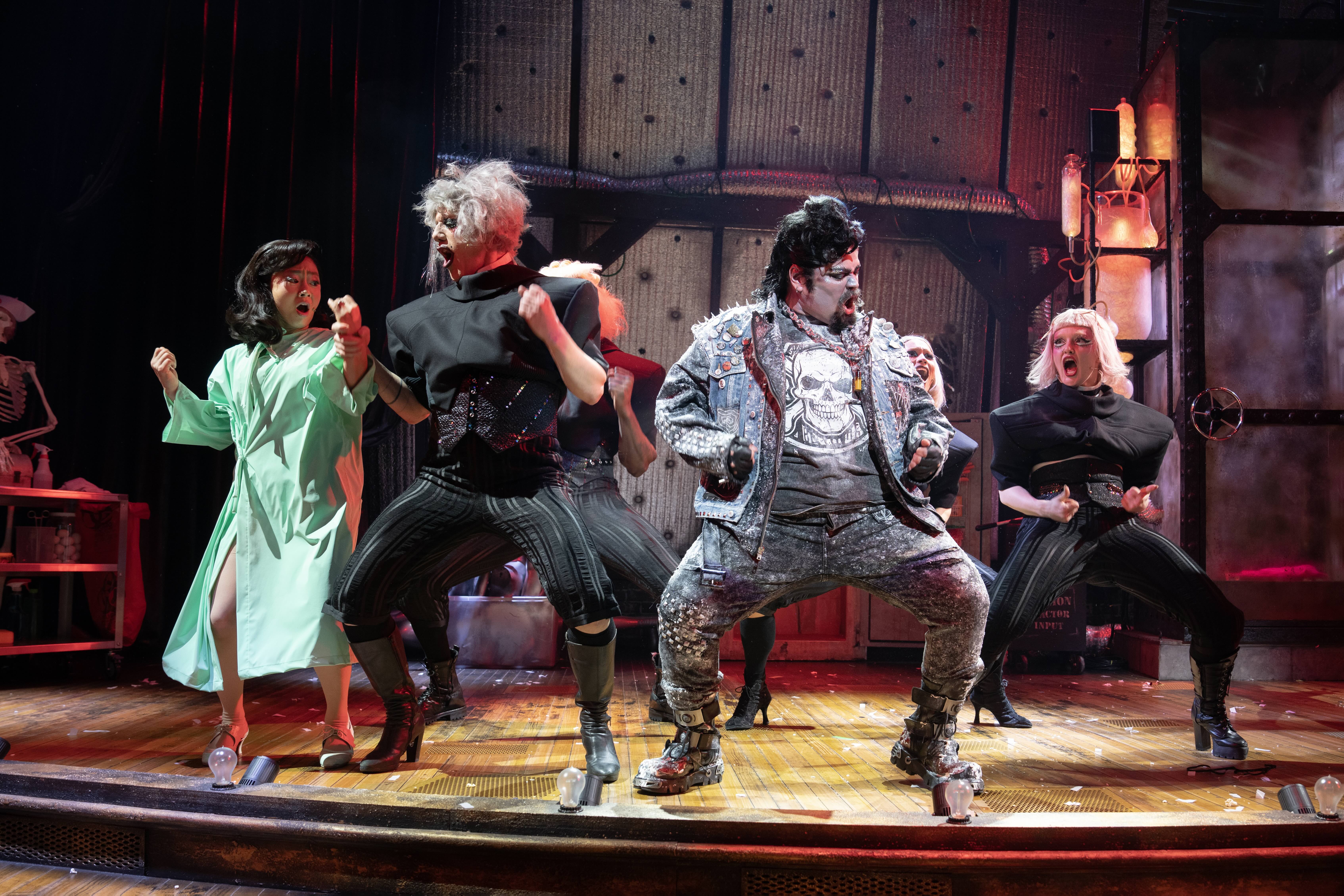
Rocky Horror’s plot is a collage of B-movie tropes lovingly bodysnatched by glam and the sexual revolution: we follow virginal fiancées Brad (Andrew Durand) and Janet (Hsu), who, stranded by a flat tire, seek help at the closest foreboding castle. Hsu and Durand give commendable zest to their characters’ embodiments of zestlessness. They are greeted by Riff Raff (Gray; played by Rocky Horror writer Richard O'Brien in the film), the maleficent majordomo who—with the help of ghoulish maid Magenta (Lewis) and castle-dwelling “Transylvanians” (including Pose’s Michaela Jaé Rodriguez as Columbia)—teaches them the libidinal Time Warp line dance that’s now been thrusting pelvises in crumbling movie theaters for a half-century.
Brad (“asshole,” per the famed midnight audience callback) and Janet (“slut,” per the same) have found themselves in the lair of Dr. Frank-N-Frurter, the genderfucking walking mojo played by Evans in an enormous, generous performance. (This mad scientist may himself be from a Transylvania many lightyears away from that of Vlad the Impaler and mămăligă.) As Brad and Janet are pulled into the castle’s degenerate depths, they become reluctant participants in their own liberation. Were only their onstage liberation a little more ecstatic in this production, it might have felt less prescriptive for me as well.
With Cole Escola’s Oh, Mary!, Josh Sharp’s ta-da!, and Morgan Bassichis’ Can I Be Frank?, Pinkleton has done glorious work and earned a reputation as the go-to theater director for slyly transgressive queer millennial oddball comedy, and he clearly treats Rocky Horror with ancestral reverence. Due to the film’s renown, any cast of any production essentially becomes its own shadowcast: whose voice one hears atop their hallowed forebears. Pinkleton and Evans cannily anticipated this doubling with Frank’s delivery of the infamous line “I see you quiver with antici…pation.” The pause in the film crystallizes the meaning of the word, but the pause in this revival adds a third layer of suspense: a moment for the audience to wonder if Evans will deliver “‘pation” like ur-Frank, Tim Curry (who originated the role on the West End before his breakout performance in the film). Instead of Curry’s relishing punctuation, he draws out the last syllable in booming vibrato. Fitting the magisterial role, he’s the cast member who most keenly commands the audience’s anticipation and reroutes it toward surprise.
Others (Dratch as the deadpan Narrator, improvising with the audience’s bawdy interruptions; Hsu, savoring Janet’s suppressed id; What We Do in the Shadows’ Harvey Guillén in the divinely goofy double role of Frank’s ex Eddie and Dr. Scott) inject as much life as they can into the entropic second half, in which the orgiastic order of Frank’s world fractures. But as a whole, the cast seldom alchemize their appealing mismatch into momentum, and Pinkleton never quite channels their discordant energies into the weird harmony he seeks. The audience’s energy felt at times greater than that onstage.
There is, of course, beautiful time warp-y potential in restoring Studio 54 (where the production is presented by Roundabout Theatre Company) to 70s liberatory chaos. Scenic design collective dots have playfully wrapped the theater in flexible ductwork, as though DIYing a contraption to harness its storied energy. A scattering of alien-coded silver mannequins act as an elegantly chintzy synthesis of Rocky Horror’s collision of posthuman silliness and the powers of human corporeality. Costume designer David I. Reynoso has some fun finding the expressive possibilities of jock straps, garters, and Spirit Halloween-y aesthetics—but the very welcome presence of two boa-tailed cyclops can-can dancers draws attention to how much wilder the rest of it could be. It’s just playful enough to play it safe.

Pinkleton emphasized to Broadway.com that beneath the “ridiculousness” of Rocky Horror is something “dead serious.” It’s undeniable that Rocky Horror has become a sort of carnal Wizard of Oz, a fantasy of queer possibility thriving somewhere over the rainbow. As though furiously underlining “dead serious” in a note to self, the show’s thesis “Don’t Dream It, Be It” in this production descends from the ceiling as a giant neon aphorism. Regardless of what one thinks of the original Rocky Horror, its creation only four years after Stonewall certainly embodied “don’t dream it, be it”; Pinkleton’s production feels more like a respectful quotation.
This Rocky is paradoxically bound by fandom’s expectations, while its greatest excitement and danger also comes from fans deciding it’s okay to vocally interject in a Broadway show. Perhaps there’s a reason the film needed shadowcasts and codified audience participation, a disjointed collective fervor, to become the paradigmatic cult classic: these added formulas counterbalance its listless wanderings with giddy religiosity. As in any type of zealotry, the mighty energy of worship fills in for what’s unseen or unproven. The belief can be off-putting to those who don’t buy it. But the belief is also the star.
--
The Rocky Horror Show is produced by Roundabout Theatre Company and is currently running on Broadway at Studio 54 through November 29, 2026.