
An Overture:
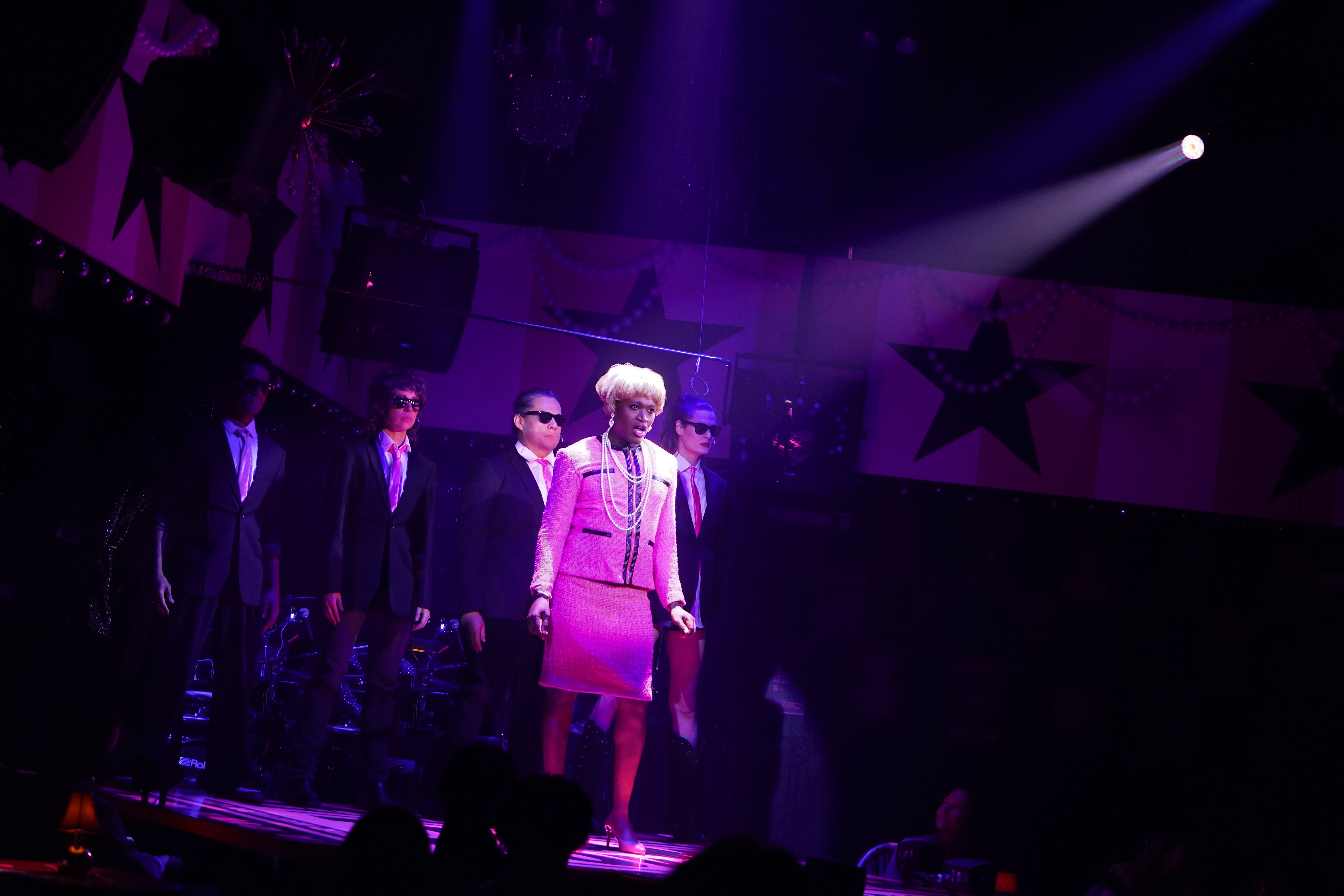
Ms. Blakk for President, a new work by Tarell Alvin McCraney and Tina Landau, is something of a memory play—a composite of direct address, found video footage, and omnidirectional drag fantasia. It covers only a portion of its subject’s life. And while the cliché is that years pass more quickly the longer we live, Ms. Blakk for President decelerates. The entirety of a youth becomes a passing moment, and only a few days of Ms. Blakk’s mid-thirties consume about a third of the play’s 100-minute runtime.
Ms. Blakk features Ato Blankson-Wood in the titular role, as well as Gideon Glick, Nic Ashe, Kelvin Moon Loh, Sawyer Smith, and Adina Verson. Glick portrays the most important person in this slice of Ms. Blakk’s life, while Ashe, Loh, Smith, and Verson take on the herculean task of portraying everyone else worth knowing.
These are some of the questions I asked myself as I tried to figure out the substantive offerings of a play that’s fluent in the language of spectacle.

Question: What is Ms. Blakk for President about?
Answer: It’s about Joan Jett Blakk, the first and only Black drag queen to run for President of the United States. According to the Vineyard Theatre’s website, it’s “[i]nspired—but not bound—by the true story of drag performer and activist Terence Alan Smith.” To that point, it only covers Ms. Blakk’s 1992 bid; she also ran in 1996.
Question: So it’s not 100% true?
Answer: No. But the play makes the case that fiction—specifically, farce—has the power to stress reality’s contradictions. Stress as in “to emphasize.” Stress as in “to burden.” Therefore, I am inclined to read the play as though it is essentially true, even if it’s not historically accurate all the time.
Question: What ideas does the play stress?
Answer: The legitimacy of the two-party system. The mandate of the Democratic Party. The primacy of the proscenium stage. The obsolescence of the Phillips CRT TV.
Questions: What else?
Answer: As Ms. Blakk moves through the play, she grows in her realization that the best version of Ms. Blakk is one that integrates ideology into her political theater—a fool, in the Shakespearean sense. Even as Mark (Gideon Glick), her white campaign manager and closest friend, insists that Ms. Blakk’s lane is spectacle (Mark’s lane, meanwhile, is substance).
And every time Mark attempted to reduce Ms. Blakk to a clown show, I felt another idea become burdened—that the most politically radical among us have escaped the foundational tropes that organize American life.
With Ms. Blakk cast in the role of Clown, the project becomes a subversive idea built on an agreeable foundation. A Drag Queen President is transgressive; a happy-go-lucky Black person with plenty on their face and nothing inside their head is a familiar script.
And I want to believe that the play knows that it’s critiquing myopic left-wing political action. Because Terence is always alive inside Blankson-Woods’ portrayal of Ms. Blakk. She articulates her ideas—at least to us, the audience of her dream world—and those ideas are not the untethered fiction of an underdrawn drag character. Ms. Blakk’s ultimate appearance drives home the point that Terence and Joan are actually the same, one, whole person: Wig designer Ashley Wise has her wear natural locs, rather than her usual blonde bob wig.
Complicating my belief is…
Question: What ideas does the play leave alone? What does it assume?
Answer: That America is something we should want.
That it’s something a Black queer person can someday have.
That a President of the United States is a thing that should exist.
(I especially felt this last assumption in Ms. Blakk’s climactic monologue. In one of the only nods to the present day, Ms. Blakk argues that if we do not change our political ways, we will have hell to pay in 2028. My audience “mmm”’ed in that way NYC audiences are wont to do. The United States Presidency retained not only a collectively agreed-upon legitimacy, but its position as the north star towards which our politics should be oriented.)
Question: Are these reasonable assumptions?
Answer: No
No
No
Question: Why not?
Answer: America as nation-state, as concept, as entity, as corporation, as matrix, as emissary, as purveyor of soft power, as the sprawling terrain on which a military-industrial complex was built, as one big red line, as school bussing, as unnatural disasters, as gun violence, as smallpox blankets. Is this something you want?
Another rhetorical question: Is it possible to possess something that can only be realized through your dispossession?
And a statement. A fish rots from the head.
An aside that’s actually a thesis:
Ms. Blakk steps up to the precipice. She sees that the Republicans don’t care. The Democrats don’t really care. The bit character who recognizes the false choice of a two-party system definitely doesn't care. Even her allies peddle harmful tropes to serve their political objectives.
But Ms. Blakk, the play, backs away from the ledge, leaving Ms. Blakk, the character, buckling under the weight of the play’s provocations.

Question: What else does the play have to say to us about the presidential election to come in 2028?
Answer: We can decide what it looks like to fail, and to succeed.
Do not let politicians play in your face, just because they’ve recruited various surrogates to say the right things, and original dreamgirls to sing songs off their “original classic soul album.”
Ideology cannot be neatly bucketed into political parties. Even a blue tsunami, the aftershock of the 2026 midterm elections, is something to be skeptical of. True. (Though I do believe that Texans are entitled to 72 hours of libbing out, as a treat.)
Question: What did the play say to me in 2026?
Answer: See above. I actually wish it spent more time listening.
The play trafficked in rhetorical questions, yet handled them unevenly. Sometimes, actors waited for the audience to respond to the question they’d posed; other times, the actor’s next line appeared spontaneously, unprompted by anything the audience may have had to say.
The audience cannot dictate the action of a scripted play, no matter how porous the boundary between spectator seating and audience playspace, thanks to David Zinn’s pink and black, chandeliered, quasi-immersive, in-the-same-universe-as-a-runway set design. But by drawing attention to the predetermined nature of theatre, Ms. Blakk heightens the sense that the audience is, in fact, spectator, not participant—even more so than a play with a structurally uncompromised fourth wall.
Anything that intimates that the audience’s point of view doesn’t actually matter feels especially unuseful to a play that argues that We The People can change our material conditions.
Question: If you had the chance, what would you, Ekemini, ask?
Answer: Is “Jett” a reference to Jet Magazine (alongside Joan Jett) or was that a happy accident?
And
What's the version of this play that steps off the ledge?
--
Ms. Blakk for President is playing now through November 29 at the Vineyard Theatre.