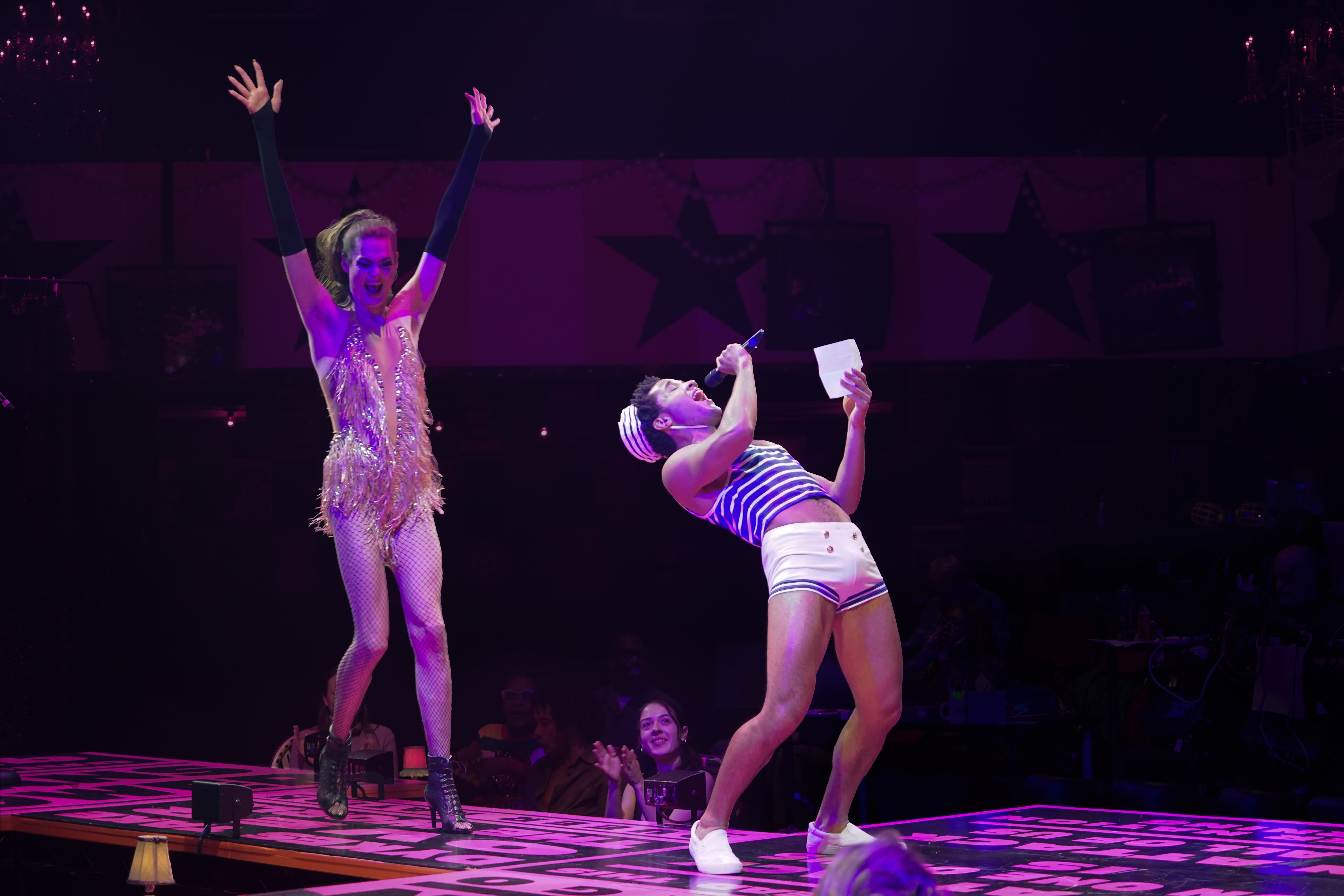

The more I’ve learned about America’s history, the more I’ve felt powerless to prevent us from repeating it. Whether it be the apparent uselessness of the popular vote in presidential elections (thanks, electoral college) or the unregulated power of the rich to sway political campaigns (thanks, Citizens United), I’m consistently reminded of how little power I have as an individual to enact change. But Black, queer history shows that nothing is impossible, and at the Vineyard Theatre, that history is onstage and covered in glitter.
Ms. Blakk for President, co-written by Tina Landau and Tarell Alvin McCraney, reimagines the true story of Terence Alan Smith, the first (and only) Black Drag Queen presidential candidate, as a queer fantasia that is part campaign rally, part nightclub performance, part confessional—and all party. Joan Jett Blakk, Smith’s drag persona, proved that anyone can make a splash and incite change. Though Blakk’s political career was short-lived, she made history in 1992 when she stormed the floor of the Democratic National Convention in full drag and demanded to be seen. Now, decades later, her story goes from a paragraph in a queer history to off-Broadway!
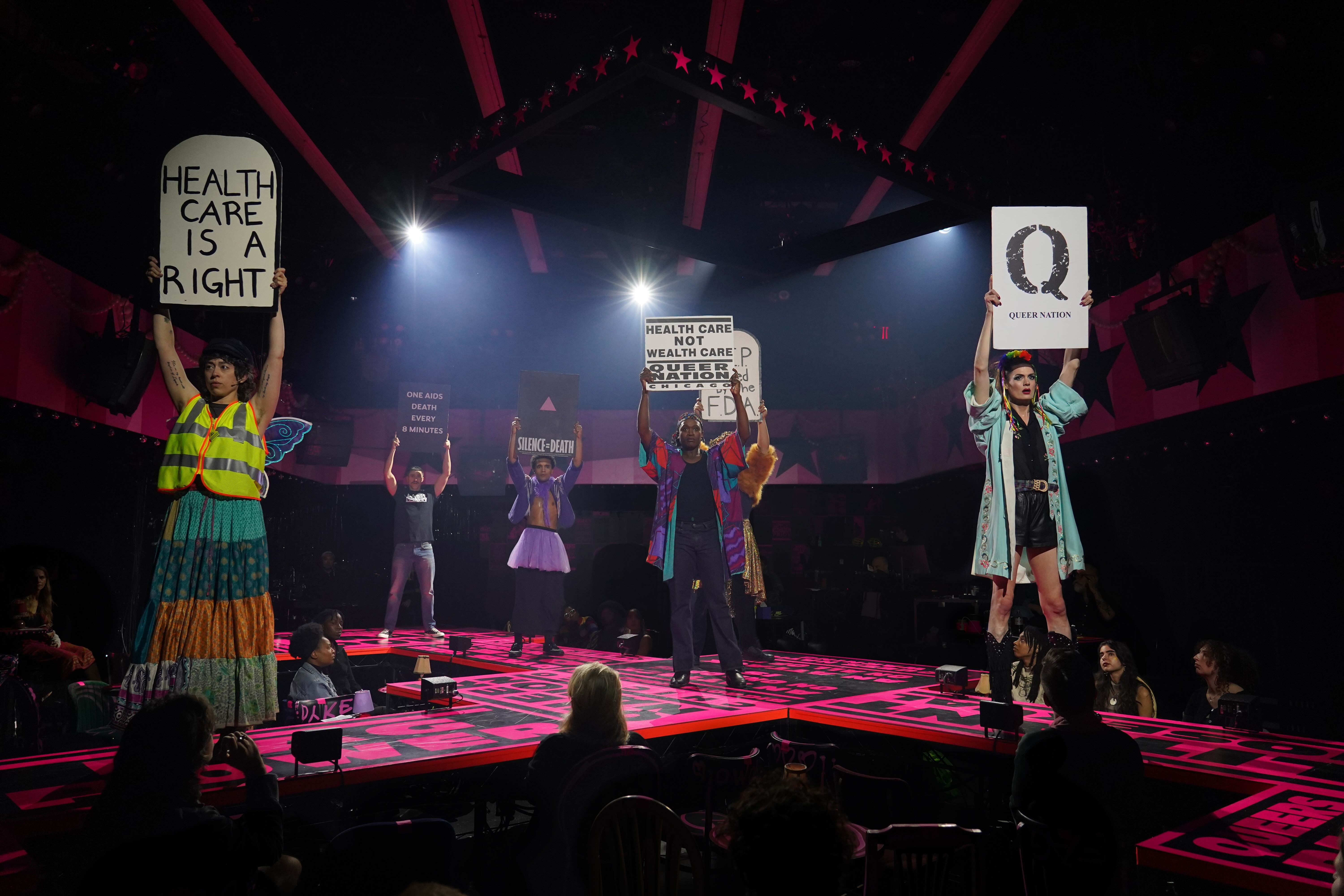
I was enthralled by the production from the minute I walked into the Vineyard. Before entering the theater, several lobby installations ground you in the world of the story, including historical timelines and commemorations of loved ones lost to the AIDS crisis (scenic design is by David Zinn). I held the spirit of my departed uncle Michael close to my heart as I moved throughout the space. Covered in political and queer art, the theater bombards the senses in a way that is both overstimulating and welcoming–mirroring the way the story is told.
Deziré Tibbs: I’m struck by the piece’s structure. There are songs, dance numbers, political theory, and some really touching character moments. How did you decide that was the way to tell this story?
Tarell Alvin McCraney: Tina and I always said that we wanted to tell a queer version of this story because that was the modality in which Terence operated. He wrote songs, so we sang songs. There were so many parts of him and his life that we wanted to have embedded in the piece as the actual theatrical modalities at work.
In my own work, I’ve been exploring the concept of “queer dramaturgy.” I find that traditional, Aristotelian storytelling often flattens the narratives of minority communities. Those stories suffer because the storytelling modality is incongruous with the content of the story itself, so I applaud McCraney and Landau for embracing their subject’s innovation and bucking of tradition when adapting his story. The use of drag and musical performance further elevated Smith’s story to theatrical heights and created a robust world for the audience to get lost in. Rather than showcasing researchable historical events, it’s as if the audience is hearing the story directly from Smith late at night in a Chicago drag bar.
Tibbs: The play premiered at Steppenwolf in 2019 at the end of Trump’s first presidency. And here we are, now, in the middle of his second term. How does Ms. Blakk speak to 2026 audiences?
McCraney: Part of the reason we started working on the show in the first place was that, regardless of where we are politically, there are things that need to change. The stigma around HIV and AIDS has gotten better, but it’s not gone. As someone whose mother died of AIDS-related complications, I’m so grateful that there’s been so much progress in treatment and medicine distribution. To be in an era where it's all being threatened is terrifying.
Tibbs: Even the history of it is being threatened.
McCraney: Exactly. Before working on Ms. Blakk, I didn’t know how Queer Nation’s fight for visibility laid the groundwork for the freedoms I have today. We have a long, rich history of people that had to fight for the things we consider to be basic human needs, and we have to understand the history to keep the fight going. The play doesn’t function as a history lesson, but it does take us through the experiences of people living in that moment, and a person deciding that they’ve got to do something.
The question of what is the “right” to be seen is at the heart of Ms. Blakk. Throughout the play, Blakk (played by Tony nominee Ato Blankson-Wood) refuses to abandon her whimsical and flamboyant nature, causing her detractors, even those within the queer community, to label her as a “joke” and exclaim that her flamboyance will be a detriment to the entire community…or at least those that consider themselves “normal.” Even members of Queer Nation insisted she needed to be more palatable to be taken seriously. I felt empowered by Blakk’s surety of self in the face of this judgement. These arguments parallel the current division in the queer community. (I’m thinking specifically of the “No Kink at Pride” and “LGB without the T” movements, which disregard the roots of the queer liberation movement in the name of assimilation). We’re critiqued for being too loud and too noticeable when this visibility is, in fact, what sparked progressive change. As McCraney so eloquently puts it…
McCraney: In the midst of so much death and governmental discrimination, Terence showed up fully as himself saying, ‘There has to be as much room for me as there is for you. And if you cannot imagine that, then you are not imagining the best America.’ Terence understood that if you showed people a good time and really engaged with them, they’re more likely to listen. You’re more likely to change their mind because you’re showing that you’re not trying to change them. We learned that you have to get in people's faces.
Tibbs: Is getting the attention enough? What is the function of that representation? Some people describe Smith’s campaign as unsuccessful because he didn’t win.
McCraney: Smith’s story matters. They didn’t know that someday almost 40 years later, someone would pick up a book and be inspired by a paragraph with this story. And I know for me, it’s galvanized me to get local and politically involved in my community. The more we singularly focus on the big picture, the more that those small changes feel like they don’t matter. In truth, down to the studs is really where you have to go sometimes. Every street corner counts. Every heart changed adds up.
We see national headlines about the upsets in Texas and Georgia. Incredible victories in Ohio and Mississippi for the first time since Reconstruction. But Angie Nixon came within 2% of winning the Senate race in Florida with no national help until the last minute. In a state that Trump won by 13 points in the last election. And she did it knocking on one door at a time. A lot of change comes from a “loss.”
To me, this last phrase encapsulates the thesis of Ms. Blakk and showcases the necessity of this story. Through engagement and investment in community, a single person can create lasting change, and we mustn’t discount the small victories along the way.
--
Ms. Blakk for President is playing now through November 29 at the Vineyard Theatre.