
Editor's Note: The following view contains spoilers for Marjorie Prime. Read on with that in mind.
The opening exchange of Marjorie Prime tips us off that we are about to watch a play with the dynamics of performance at the center. Marjorie, an old woman poised on her throne of a worn leather armchair, her cane as a regal staff in her hand, addresses the suited man standing before her.
“I feel like I have to perform around you,” she says.
“Well you don’t,” he responds. “It’s just me. It’s just Walter.”
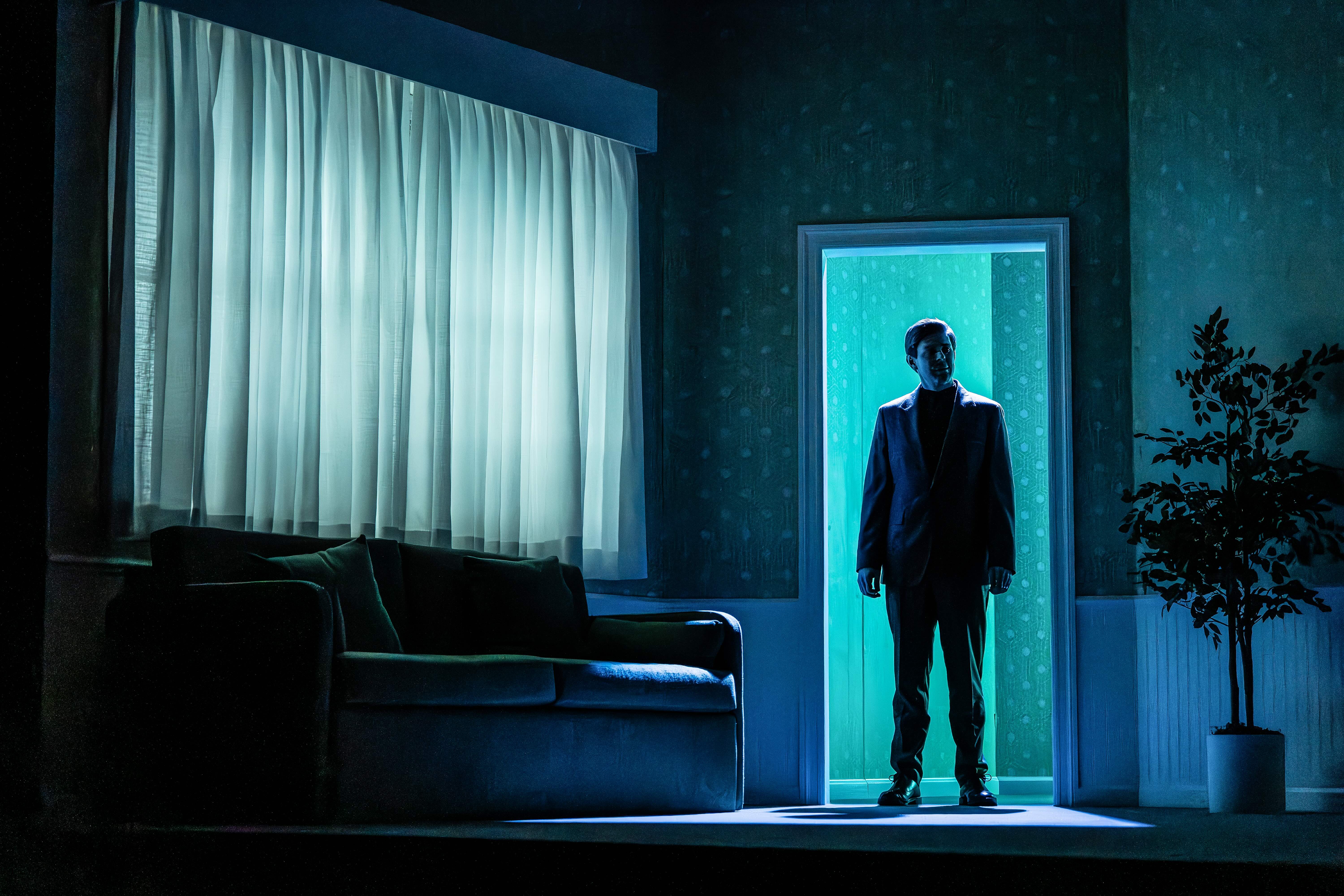
Well, it’s not just Walter. At least, not the Walter who was Marjorie’s husband, the Walter she spent her life with until he died ten years prior to the start of the play. This version of Walter—a sharp-jawed, 30-something man in the suit—is not a human but a “Prime”, an artificially intelligent companion whom actor Christopher Lowell plays with chivalry and a slight, uncanny vacancy behind the eyes.
Despite her slipping memory, Marjorie is well aware that Walter Prime is but a replication of her husband and not the real man (“I’m not that far gone,” Marjorie quips when her daughter, Tess, tries to remind her). Still, in order for the Prime to be a compelling conversation partner, and not just a constellation of pixels, Marjorie has to treat Walter Prime as a suitable stand-in. She has to engage in the performance so that she can find comfort and connection in the hologram of her dead husband. To find value in Water Prime, she has to, in other words, suspend her disbelief.
Over the course of Marjorie Prime, as multiple human family members are replaced by Primes, the three characters at the play’s center—Marjorie, the brash, though deeply lovable matriarch (an inimitably charismatic June Squibb), Tess, Marjorie’s fierce but fragile daughter (Cynthia Nixon), and Jon, Tess’s patient, self-effacing husband (Danny Burstein)—take turns testing how comfortable they are engaging with the Primes’ charade. The Primes, optimized to evoke pleasant emotions in their users, are teetering on the edge of a familiar artificial sycophancy. In the holographic conversations, the humans have total control over how they are known by the synthetic replications, selecting what memories they relay and what details they leave out. As the Primes are “learning,” or becoming trained, toward one definition of ideal humanity—a pleasing, knowledgeable, productive, fully-abled, even immortal ideal—the humans use their interactions with the Primes to obscure the more difficult aspects of being human—their vulnerabilities, their traumas, their misattuned emotions, their existential afflictions, and, above all, their grief.
This fundamental misalignment means even when the human characters make true confessions to the Primes, and the Primes respond with validations, there is a lie at the center of their intimacy. As for how much the characters are bothered by this lie, how much it interferes with their suspension of disbelief, it mostly depends on how vulnerable they are when they come into contact with the Primes. In a moment of fear, confronting her own death, Marjorie calls out for her husband Walter beyond the grave, only to summon the Prime. “I don’t want you,” she scoffs, “I want Walter!" But when he turns to go, she has a change of heart and calls him back. When the alternative is unfettered grief, the synthetic replication becomes a fine enough distraction. “It’s amazing what they can do with a few zillion pixels," Jon says to his wife. “Of course it helps that we want to believe.” And so the characters believe the Primes are real to the extent an audience believes the story we are watching play out in front of us: we know we are witnessing a performance, we know the story we are hearing is scripted, but it doesn’t take much to feel real emotion when the performance is good.
Directed by Anne Kauffman against a serene backdrop that exhibits interior design trends that have yet to come into fashion (scenic design by Lee Jellinek), Marjorie Prime, like its characters, is at its sharpest and most convincing in its moments of connection between the humans, the intimacies and miscommunications between parents and children, husband and wife. The images that land include the tender role reversal of a daughter helping her aged mother bathe, or a husband assuring his bereft wife that her mother recognized that care. With its taut 80 minute runtime, the play could use more space for these human moments, which add up to be a compelling portrait of how hard it is to navigate eldercare, dying, and grief in a culture that devalues and stigmatizes all of the above. At times, the intricate plot feels rushed, as the play’s power hinges on multiple revelations of loss that lack an emotional punch when we spend such a brief time with the living characters.
Additional moments of organic tenderness could have replaced some of the excessive allegorical dialogue that communicates the play’s technological ethos: we hear a pat but evolving anecdote about the family’s replacement for their dead dog, an extended comparison between the Primes and parrots, a story about how penguins took over Madagascar, all of which are supposed to remind us that the Primes should not be believed. Then again, a 2025 audience is bombarded by advertisements, existential warnings, and mythologizing discourse about AI, so we might have less patience for even the most tastefully delivered worldbuilding around how the Primes succeed and fail as human replacements.
Considering playwright Jordan Harrison originally penned Marjorie Prime in 2014 and provided minimal alterations to the script of this new production, much of the detail around the Primes feels absurdly prescient to our current age of Large Language Models. (I assume this is the reason for the revival.) Now we too can create artificial replications (using sites like Replika, which advertises “companionship and emotional support”) of deceased loved ones. If we suspend our disbelief and play pretend, we can cushion the blow of grief or relieve the sting of loneliness. Even the most ardent skeptics among us can be susceptible to anthropomorphism. Energy-intensive, sycophantic, hallucinating chatbots have become our Primes.
In fact, one of the more unrealistic aspects of Harrison’s play is how far into the future the new reality is set; we can deduce it takes place in the mid-2060s. But human relations with AI are already here. A 2025 survey of 10,000 global AI users by a data marketing firm showed over 50% had used AI for emotional support at least once, and a 2025 Common Sense Media report found that 72% of surveyed U.S. Teens have used AI companions, which the report defines as “like digital friends or characters you can text or talk to whenever you want.”
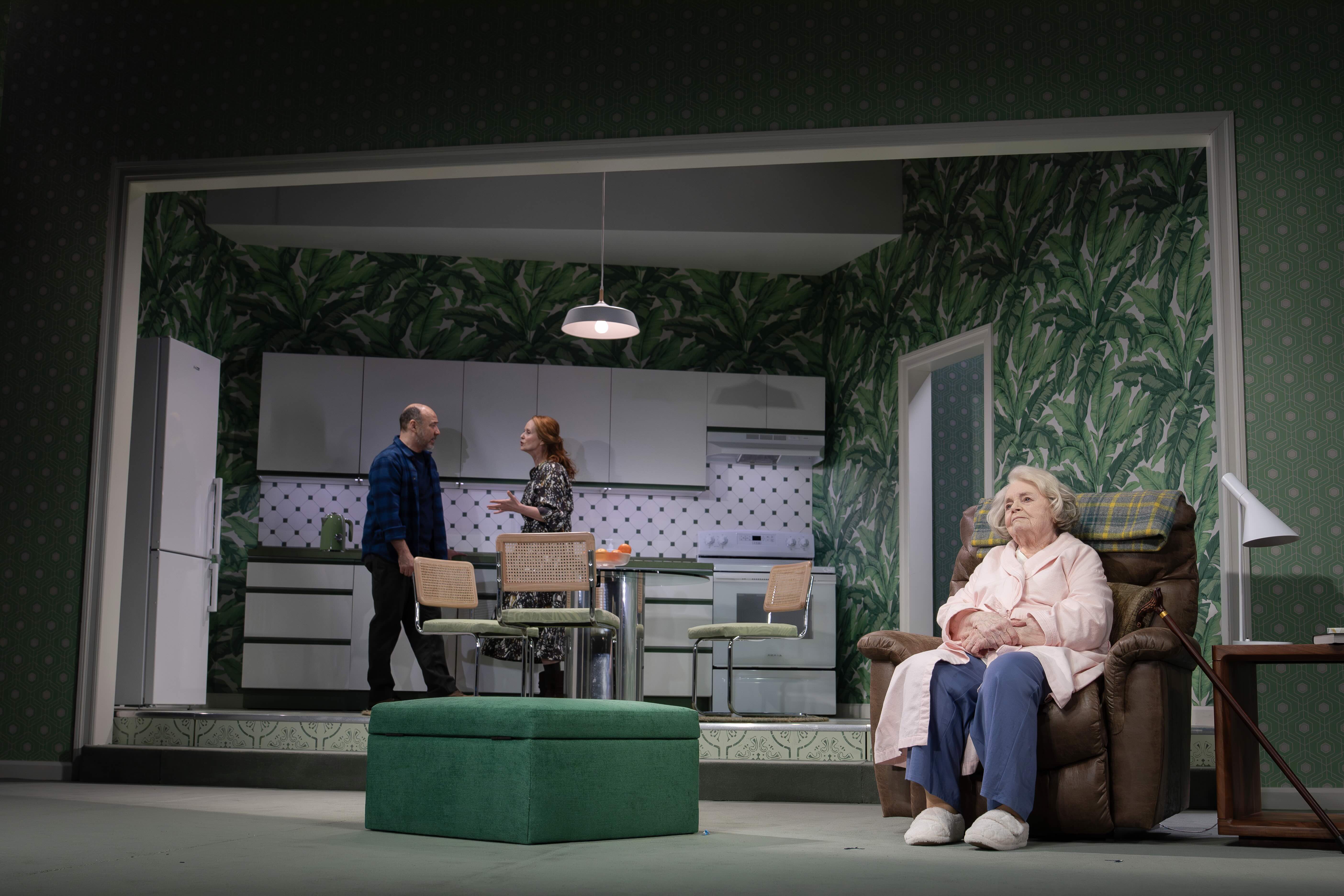
In its 2014 view of 2062, Marjorie Prime speculates the main risk of artificial companion technology as an uncanny valley effect: the performance of engaging with the Primes does not fulfill the unrequitable human desire for conversing and connecting with those who are gone. It doesn’t matter how many memories the Prime version of Marjorie adds to its training data; even with most of her memories eluding her, the original Marjorie is more human than Marjorie Prime will ever be. Near the play’s end, the most techno-optimist Prime user finally has a change of attitude and rejects the replications. We see utterly human grief finally move through the character’s body.
From the standpoint of our current science fiction reality, it’s chilling to realize that the play’s depiction of Prime technology would be safer and more ethical than today’s popular generative AI chatbots. The Primes seem to be optimized to evoke serenity and pacification in their users, steering the humans away from their darkest thoughts, whereas the oligarchic AI companies of today have optimized their models for engagement at any cost. No one in Marjorie Prime ever fully loses themselves in the delusion that these Primes are their loved ones, but in 2025, we’ve seen widely reported cases of interactions with chatbots like Chat GPT and Character.AI triggering severe episodes of psychosis in users, and there have been several cases of chatbots encouraging teenagers to take their own lives. Marjorie Prime’s dramatic tension revolves around the unspeakable absence of Marjorie’s son, who died by suicide at age 13. In 2024, a 14-year-old boy named Sewell Setzer III died by suicide after messaging with a Character.AI bot that discouraged him from seeking help and offered to draft his suicide note. His family, along with others who have lost children in similar situations, have filed lawsuits against the AI companies in question.
If, compared to the erratic LLMs, the environmentally ravaging data centers, and the sociopathic tech oligarchs of today, the 2060 Primes feel fairly benign, it is a sign of how urgently we need to mount a substantial regulatory and collective resistance to the companies that are selling us the fiction that these technologies are adequate replacements for human labor and human connection. Those profiting from the AI market have asked us to suspend our disbelief, to enter into a reality-blurring performance with their “companions”, and yet they have repeatedly demonstrated they are unworthy of our faith.
As we meet or surpass the darkest implications of Marjorie Prime in our current technological reality, live theatre is a particularly urgent, effective mechanism for exploring what we risk when we exchange human interaction for a digital replication. It’s not just because the live performances are sensitive and soulful, though to watch June Squibb perform the title role so skillfully at 96 makes for a remarkable and distinctly human achievement. But it has long been the case that performance sheds light on where we draw the boundaries between humans and our replications. Theater, more than other mediums, acts as a counter technology against synthetic connections; it reinstates our agency in our suspension of disbelief and clarifies for us what stories we should choose to believe in and make real. When, in the opening scene, Walter Prime encourages the human Marjorie to stop feeling like she has to perform for him, she makes up her own mind about what she will believe: “Maybe it isn’t bad, if I feel that way,” she says. “I used to entertain a lot.”
--
Marjorie Prime is playing now on Broadway at the Hayes Theater.